
Stories from the Deep:
Karen Klim, Seen and Unseen
5 - 27 september 2026
Where the eye cannot quite reach
There is something contradictory about glass. It invites us to look through it, yet never quite allows us to see everything. It can appear liquid when it is solid, delicate when it is surprisingly weighty. And transparency, as Karen Klim reminds us, does not necessarily mean revelation.
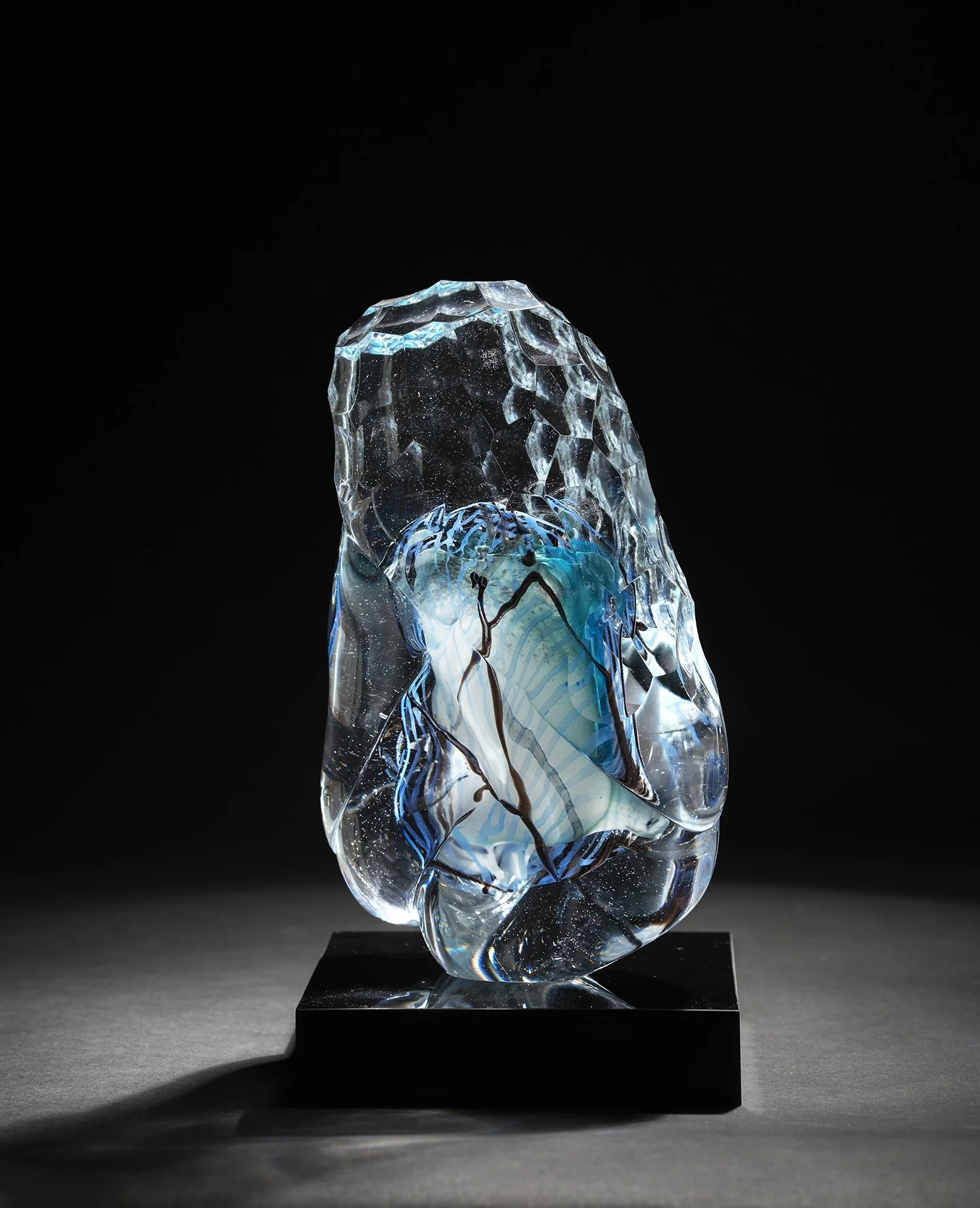
The title Stories from the Deep initially suggests a descent into some mysterious world beneath its surface. Colours appear submerged within clear masses. Lines disappear into their depths. Forms emerge and recede.
Folds of pink that gather into a strangely intimate mass. Flesh perhaps. Something cellular, dividing and multiplying.
I find myself wanting to name it, yet each time I look again it seems to become something else. It is beautiful, but not entirely comfortably so.
Then the idea of the deep begins to shift.
Perhaps these aren't depths we descend into. Perhaps they are depths we ourselves carry. Memory. Emotion. Instinct. Things half remembered. Feelings that exist before we find words for them.
Some of Klim's forms seem almost embryonic—not because they depict anything so literally, but because they suggest something still becoming, before identity has settled into certainty.
Perhaps that is where the stories she tells begin.
What the hand remembers
After nearly five decades spent understanding what glass will and will not allow, what fascinates me is how completely her experience seems to have entered her hands.
In the heat of the furnace, coloured and clear glass are laid layer upon layer while the material remains fluid. There is only a brief window in which to work. The body moves, the hand responds, gravity intervenes. Klim speaks of spontaneity and intuition leaving their traces before the glass cools.
Then everything changes again.
She returns to the hardened object with a diamond saw. Lines are cut into forms born from softness and movement. Surfaces are ground and polished until they catch and refract light with remarkable clarity.
What happened quickly in heat is reconsidered slowly in the cold.
And looking at these objects, Nordic nature—ice, water, forest, organic growth—runs clearly through Klim’s work. But there are moments when looking doesn't seem quite enough.
Their folds, curves and polished surfaces invite touch. I want to run a finger along them, to reconcile what the eye perceives as soft and yielding with what I know must be hard and cool.
Looking into, looking through
From a distance, we see an object. Come closer and the surface gives way to an interior.
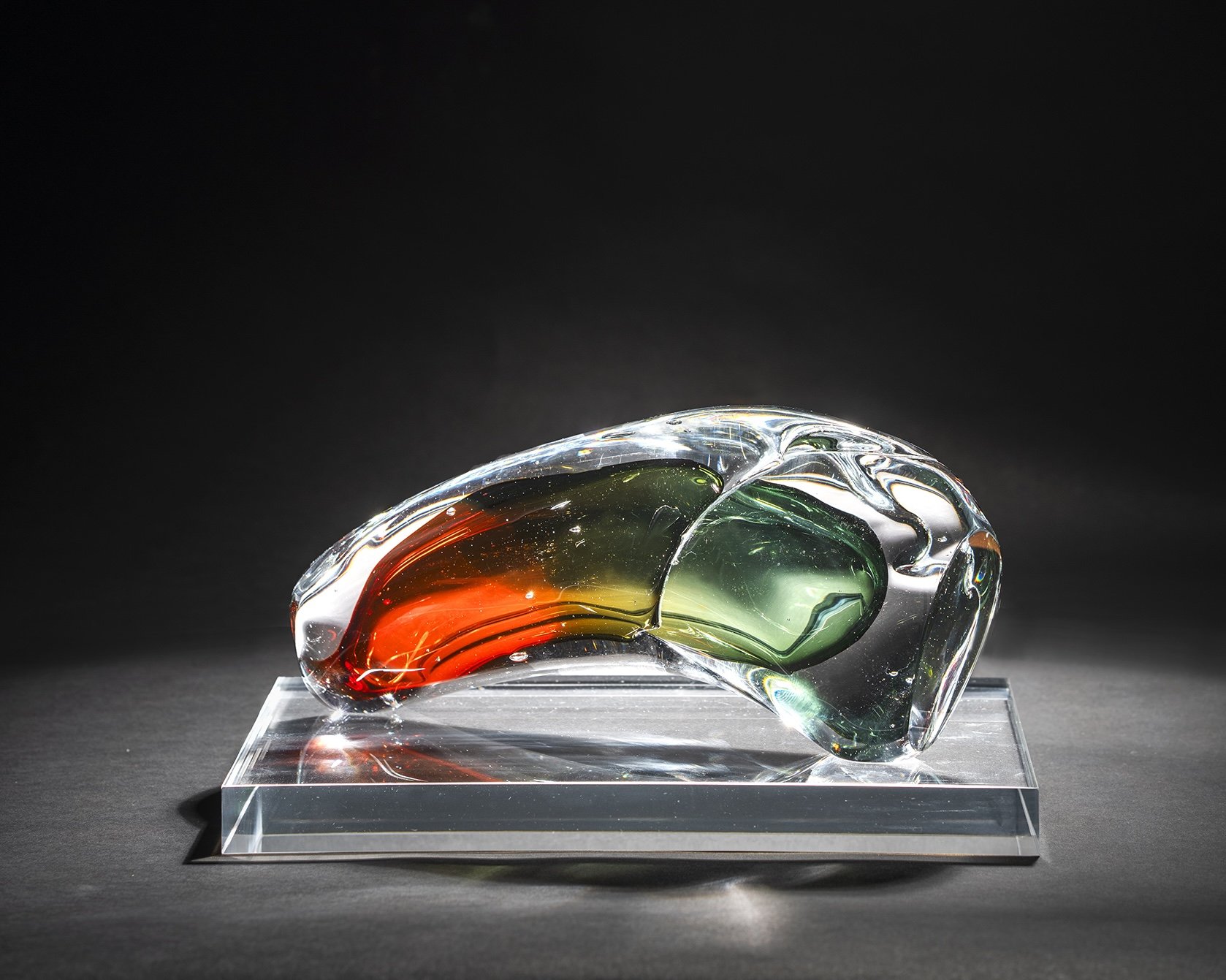
This dimensionality is part of the fascination of Klim's work. We don't simply look at it, or even around it. We peer into it and sometimes through it. Colour seems to inhabit the glass rather than decorate it. Forms appear suspended at different depths. Reflections sit on the outside while something else is happening within.
Walk around one of Klim's objects and it refuses to remain the same.
A form that seemed buried inside suddenly comes forward. Colours overlap, separate or deepen. A cut catches the light and appears where a moment earlier I had barely noticed it. Move again and something else recedes. Change the light and the experience shifts once more.
Nothing in the object has changed. Only where I am standing.
The deeper we look, the less certain it becomes.
Glass offers the promise of access while quietly withholding it. Something inside is visible, sometimes tantalisingly so, but visibility and understanding are not the same thing.
When beauty is not enough
Glass seduces.
Light, colour, translucency and sheer craftsmanship can be pleasurable enough in themselves. Klim certainly allows us that pleasure. Yet I don't think she allows us to remain there.
Her forms resist easy recognition. There are echoes of Nordic landscape and nature, certainly, but also forms that feel more intimate, even faintly unsettling. A blue-white object might suggest ice, or something glimpsed beneath water. Another appears to grow from within itself.
This is where the work becomes more interesting to me.
We instinctively search unfamiliar forms for something we recognise. Perhaps it is simply how we make sense of the world. Klim brings us close to recognition and then stops. Another angle offers another possibility. Light reveals something we had missed. What seemed familiar becomes strange again.
So the question changes.
Not simply: What am I looking at?
But: Why does this feel familiar?
The stories we carry
These are not stories in the conventional sense. There is no narrative waiting to be decoded. Klim gives us fragments and leaves us to make the connections.
Some may stir memories. Others something less identifiable—a sensation, an association, an emotion whose source we cannot quite place. Something reaches us before we have decided what it means.
Standing before Klim's glass, I am less interested in deciphering what she intended me to see than in noticing what begins to surface within me. There is enough familiarity to draw me close, but enough mystery to leave room for imagination.
And this, for me, is the journey in Stories from the Deep.
It takes us inwards. Towards those private reservoirs of memory, emotion, instinct and imagery that we carry largely unseen—and perhaps do not entirely understand ourselves.
Klim doesn't give them names.
I am beginning to think that is the point.
The glass may be transparent.
The stories are not.